
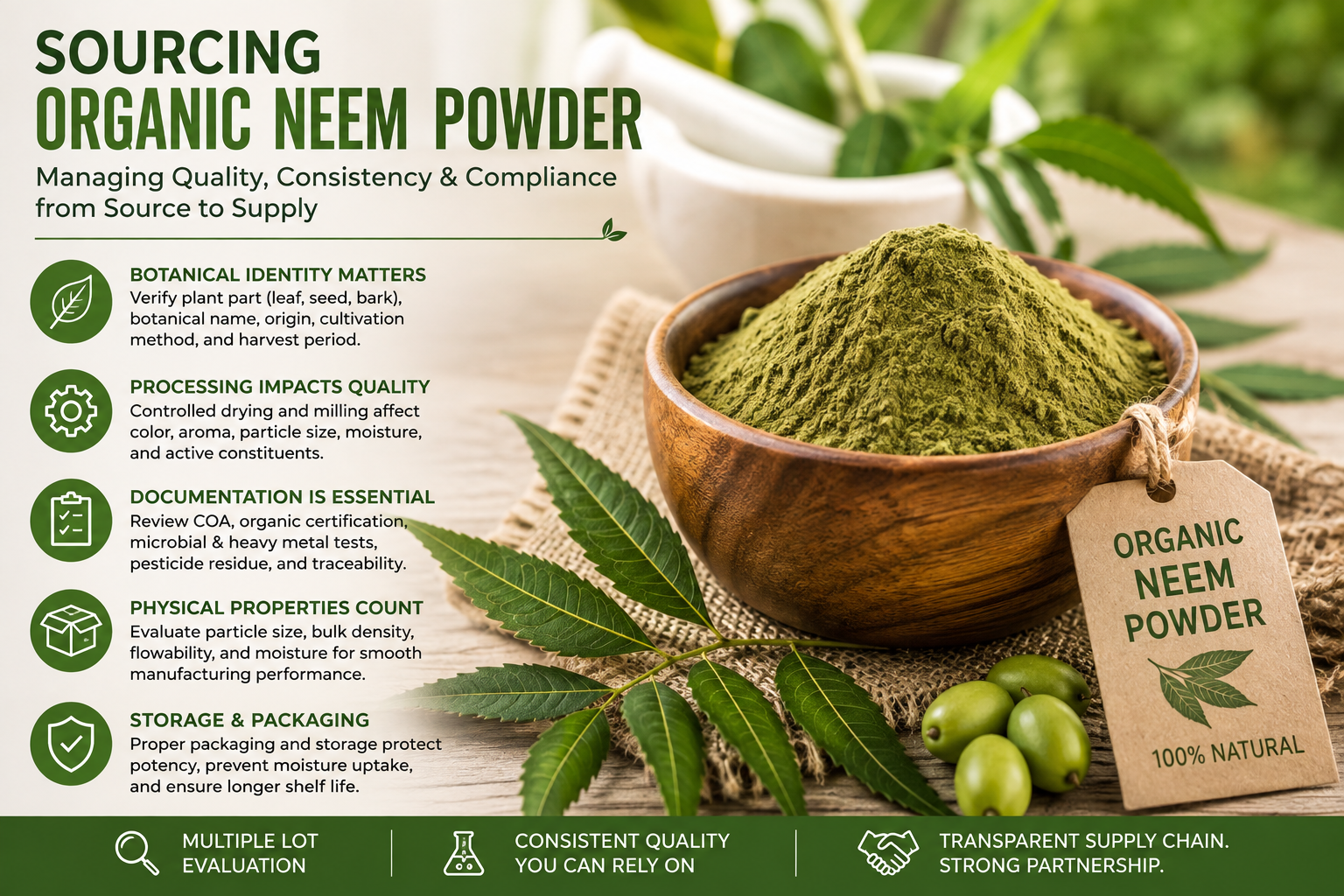
A common problem in botanical procurement is discovering that two lots of the same ingredient are not quite the same once they reach production. With Organic Neem Powder, differences in plant part, harvest conditions, drying, milling, moisture, and storage can affect how the material looks and behaves. A supplier may meet the stated specification, yet an R&D team can still encounter changes in flow, color, particle size, or formulation performance.
For companies purchasing Organic Neem Powder Bulk, the sourcing process needs to account for these practical variables rather than relying on the ingredient name or a single laboratory report.
Define Exactly What Is Being Purchased
Neem comes from Azadirachta indica, but “neem powder” is not necessarily a precise raw-material description. Commercial ingredients can be produced from leaves, bark, seeds, or other plant parts, and these materials have different compositional and physical characteristics.
For procurement teams, identifying the plant part should therefore be one of the first specification requirements. Botanical identity, cultivation region, harvest period, processing location, and drying method can provide additional visibility into the supply chain.
Organic certification is another important checkpoint. Buyers should verify that certification applies to the actual ingredient and relevant supply chain, rather than accepting a general organic statement. Traceability records can become particularly useful when suppliers source from multiple agricultural regions.
One sourcing issue worth watching is seasonal variation. Changes in crop source or harvest timing may influence color, aroma, moisture, and composition even when the finished powder continues to meet a broad specification.
Processing Can Influence the Finished Powder
Neem contains naturally occurring limonoids, flavonoids, polyphenols, fiber, proteins, minerals, and other botanical constituents. Their levels can vary with plant part, maturity, growing conditions, and processing.
Drying is one of the important processing stages. Excessive heat or prolonged exposure may influence color, aroma, and constituent retention, while inadequate drying can increase moisture-related storage concerns.
Milling introduces another set of variables. Particle-size distribution can influence bulk density, flowability, blending, and filling performance. A powder that works well in a laboratory trial may behave differently in industrial equipment if the commercial lot has a substantially different particle profile.
This is why formulation teams should evaluate physical characteristics alongside analytical specifications. Moisture, water activity, particle size, and bulk density can all become relevant during scale-up.
Application Should Determine the Specification
Organic Neem Powder may be used in botanical, personal-care, agricultural, and other applications where its use is appropriate under the applicable regulatory requirements. The intended application should determine which specifications are critical.
For example, a formulation requiring leaf powder should not be compared directly with a seed or bark powder simply because all are marketed as neem ingredients. Similarly, whole botanical powder and concentrated extract serve different technical purposes.
For R&D teams, the decision should begin with the role of the ingredient in the finished product. From there, procurement can define suitable requirements for particle size, moisture, microbiological quality, identity, and other relevant characteristics.
This approach reduces the risk of selecting a material based primarily on price when the actual formulation requires a different technical profile.
What to Check When Buying Organic Neem Powder Bulk
When evaluating Organic Neem Powder Bulk, buyers should review the COA together with supporting documentation. Depending on the application, this may include organic certification, botanical identity testing, microbiological analysis, pesticide-residue testing, heavy-metal results, allergen information, country-of-origin records, and relevant quality or food-safety certifications.
However, one of the most useful sourcing practices is to examine more than one production lot.
Compare samples for color, aroma, moisture, particle size, bulk density, flowability, and general physical consistency. If the ingredient is intended for a specific manufacturing process, pilot-scale testing can provide more useful information than visual inspection alone.
Packaging also deserves attention. Neem powder can be affected by moisture exposure during transportation and storage. Inadequate protection may lead to caking, reduced flow, or other handling problems. Buyers should consider packaging barrier properties, transportation duration, warehouse conditions, and recommended storage requirements.
Building a More Reliable Bulk Supply
For recurring Organic Neem Powder Bulk purchases, the strongest specifications are built around measurable production requirements. Procurement teams can establish acceptable ranges for moisture, particle size, bulk density, microbiological parameters, and relevant compositional characteristics.
Retaining an approved reference sample provides a practical benchmark for future deliveries. It is also useful to establish a supplier change-notification process covering plant part, agricultural source, harvest period, drying method, milling process, and manufacturing location.
These measures do not eliminate natural variation. They make it easier to identify meaningful changes before they create formulation or production issues.
Ultimately, reliable neem sourcing depends on understanding the material from its agricultural origin through final processing and storage. For manufacturers purchasing Organic Neem Powder Bulk, bringing procurement, quality, and R&D perspectives together creates a more realistic specification—and a much stronger basis for maintaining consistency as production scales.